About the Journal
Focus and Scope
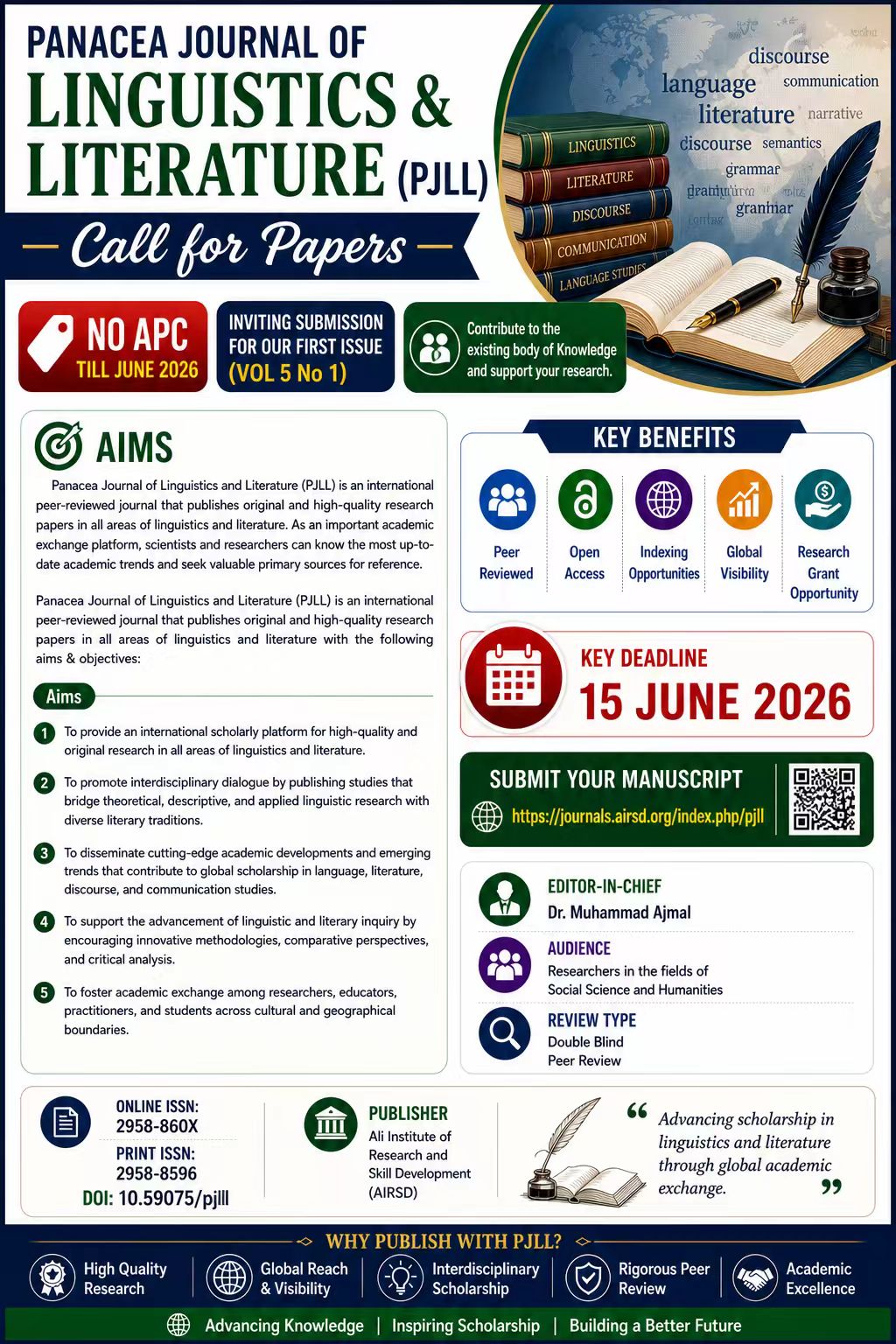
Panacea Journal of Linguistics and Literature (PJLL) is an international peer-reviewed journal that publishes original and high-quality research papers in all areas of linguistics and literature. As an important academic exchange platform, scientists and researchers can know the most up-to-date academic trends and seek valuable primary sources for reference.
Panacea Journal of Linguistics and Literature (PJLL) is an international peer-reviewed journal that publishes original and high-quality research papers in all areas of linguistics and literature with the following aims & objectives:
Aims
- To provide an international scholarly platform for high-quality and original research in all areas of linguistics and literature.
- To promote interdisciplinary dialogue by publishing studies that bridge theoretical, descriptive, and applied linguistic research with diverse literary traditions.
- To disseminate cutting-edge academic developments and emerging trends that contribute to global scholarship in language, literature, discourse, and communication studies.
- To support the advancement of linguistic and literary inquiry by encouraging innovative methodologies, comparative perspectives, and critical analysis.
- To foster academic exchange among researchers, educators, practitioners, and students across cultural and geographical boundaries.
Objectives
- To publish peer-reviewed research articles that meet international standards of originality, rigor, and scholarly relevance.
- To encompass a wide range of subfields, including theoretical, descriptive, and applied linguistics; diverse literary periods and genres; ELT; TESOL; and regional literatures such as African, American, English, and South Asian literature.
- To encourage contributions that explore global and local linguistic phenomena, literary traditions, and discourse practices.
- To facilitate access to reliable and updated academic knowledge by maintaining consistent publication schedules and high editorial quality.
- To promote the exchange of ideas between established scholars and emerging researchers through a diverse array of research papers, reviews, and critical discussions.
The journal includes, but is not limited to the following fields:
- Theoretical linguistics (cognitive linguistics, generative linguistics, functional theories of grammar, quantitative linguistics, phonology, quantitative linguistics, phonology, morphology – syntax, lexis, semantics, pragmatics);
- Descriptive linguistics (anthropological linguistics, comparative linguistics, historical linguistics, phonetics, etymology, sociolinguistics);
- Applied linguistics (computational linguistics, evolutionary linguistics, forensic linguistics, internet linguistics, language acquisition and assessment, language documentation, revitalization, development and education, linguistic anthropology, neurolinguistics, psycholinguistics, second-language acquisition);
- Literature theory, literary movements, literary evolution;
- Forms of literature, literary genre, oral and written literary genres;
- Literature by period: ancient literature, early medieval and medieval literature, renaissance literature, early modern and modern literature, comparative literature studies
- Literature concepts, literary critics, and literary criticism;
- Literature creation, authors, writers, editing, publishing, and literature distribution;
- History of literature, literature movements, biographies
- Discourse Analysis
- African Literature
- American Literature
- English Literature
- South Asian Literature
- ELT
- TESOL
Announcements
Current Issue
Articles
![]()